Cursive K: how to write the letter K in cursive
The lowercase cursive k is a tall loop like an l, then a small loop at the midline and a kick-out stroke: in Zaner-Bloser terms, undercurve, loop, slant, overcurve, loop, curve right, undercurve. It belongs to the undercurve letters (start with a swing up from the baseline) and is one of the harder letters to learn. Below you will find the capital and lowercase K on three-line guides, stroke-by-stroke instructions, practice words, and a free printable worksheet in the same school cursive style.
Lowercase k at a glance
- Strokes
- 1 (undercurve, loop, slant, overcurve, loop, curve right, undercurve)
- Starts
- at the baseline
- Ends
- with an undercurve up to the midline
- Family
- undercurve letters
Capital K at a glance
- Strokes
- 2 (curve forward, slant; double curve, double curve, undercurve)
- Starts
- at the topline
- Next letter
- joins without lifting the pencil
Capital cursive K
Lowercase cursive k
Free cursive K worksheet
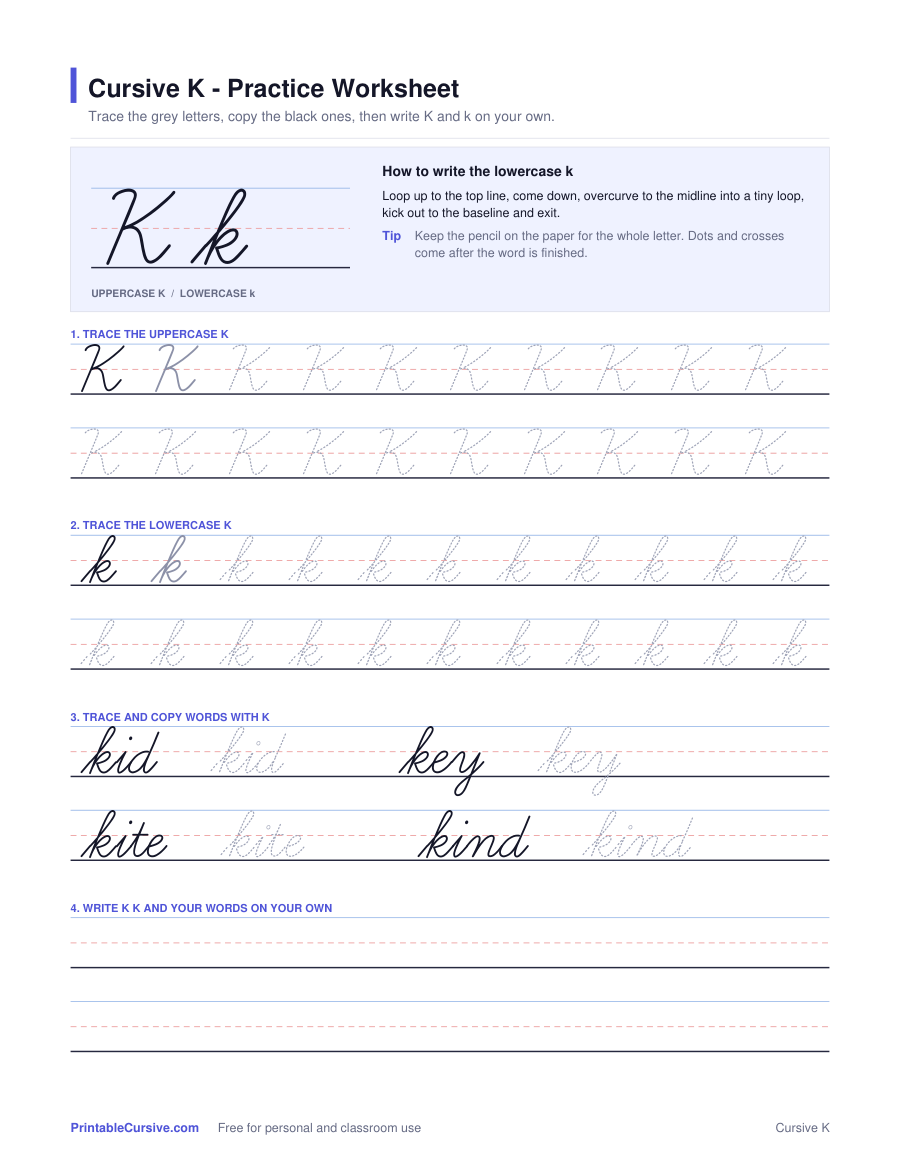
Cursive K practice worksheet
1 page · US Letter, prints on A4 · free
Capital K and lowercase k to trace, copy and write on your own, plus four practice words (kid, key, kite, king). Three-line guides, standard school cursive.
How to write a lowercase k in cursive
- Start at the baseline. Make an undercurve up to the topline.
- Make a loop back to the left and slant down to the baseline.
- Curve over to the midline and make a small loop that touches the slant.
- Curve right and down to the baseline, then make an undercurve up to the midline to join the next letter.
Tip: k is one of the hardest lowercase letters. Master h first: the k is an h whose hump collapses into a loop.
How to write a capital K in cursive
- Stroke 1: start at the topline, curve forward and slant down to the baseline.
- Stroke 2: start at the topline to the right, make a double curve in to touch the stem at the midline, then a double curve out to the baseline.
- Make an undercurve up to the midline. The capital K joins the next letter.
The capital K joins the next letter, so names and sentence openers are written in one motion.
Cursive words with the letter k
Practice the k inside real words so the joins become automatic. All of these appear on the worksheet.
Each of these words has its own page with the joins explained: see cursive words.
Common mistakes with the cursive K
- Making the small loop too big so it looks like a second letter.
- Kicking the leg out too far, which crowds the next letter.
- Skipping the small loop entirely, which produces an h.
Letters that use the same motion
The k is easier to master alongside letters that start the same way. Practice these together:
Cursive K questions
Does the capital K connect to the next letter in cursive?
Yes. In standard school cursive the capital K ends with an exit stroke that joins the next letter, so a word like "Kid" is written without lifting the pencil.
Where does the lowercase k end?
The lowercase k ends on the baseline with an upward exit stroke. The next letter starts from that stroke, which keeps the whole word connected.
Is the cursive K hard to learn?
The k is one of the harder letters of the cursive alphabet. k is one of the hardest lowercase letters. Master h first: the k is an h whose hump collapses into a loop.
Which cursive style is the K shown in?
The letters on this page and in the worksheet use the standard school cursive taught in most US classrooms (the Zaner-Bloser style). D'Nealian cursive differs slightly in slant and in a few capitals, but the strokes described here apply to both.