Teaching cursive
A practical plan for teaching cursive handwriting in a classroom or at home: a twelve-week scope and sequence, a fifteen-minute lesson structure, the order to introduce the letters, and free worksheets for each stage. It follows the traditional school cursive taught in most US schools.
A twelve-week scope and sequence
-
Weeks 1 to 2
Strokes and the first family
The four basic strokes as rows. Undercurve letters i, t, u, w, e, l. First joins: it, tie, will, let.
-
Weeks 3 to 4
Oval and overcurve letters
a, c, d, g, o, q, then n, m, v, x, y, z. Short words from the letters known so far.
-
Weeks 5 to 6
The tricky six
r, s, f, k, j, p (and b). One or two per lesson, always used inside a word the same day.
-
Weeks 7 to 8
Joins and words
The common letter pairs, bridge joins after b, o, v, w. Sight words and the students' own names.
-
Weeks 9 to 10
Capitals
C, O, U, P, A, M first, then the loop capitals, then the fourteen that stand alone (B, D, F, G, I, L, O, P, Q, S, T, V, W, X). Names, days, months.
-
Weeks 11 to 12
Sentences and free writing
Trace and copy sentences, then write from dictation and from memory on blank three-line paper.
Most third-grade classes complete this in one semester with four lessons a week. Second graders take longer; older students who missed cursive go faster.
A fifteen-minute lesson
| 2 min | Warm-up: one row of strokes or of last lesson's letter. |
| 3 min | Model the new letter on the board: say the strokes aloud, have students trace it in the air. |
| 5 min | Worksheet: trace the dashed letters, copy the solid model, then write it unaided. |
| 3 min | Use it: the new letter inside two or three words. |
| 2 min | Check: circle the best letter on the page. Students compare it with their first attempt. |
Worksheets for each stage
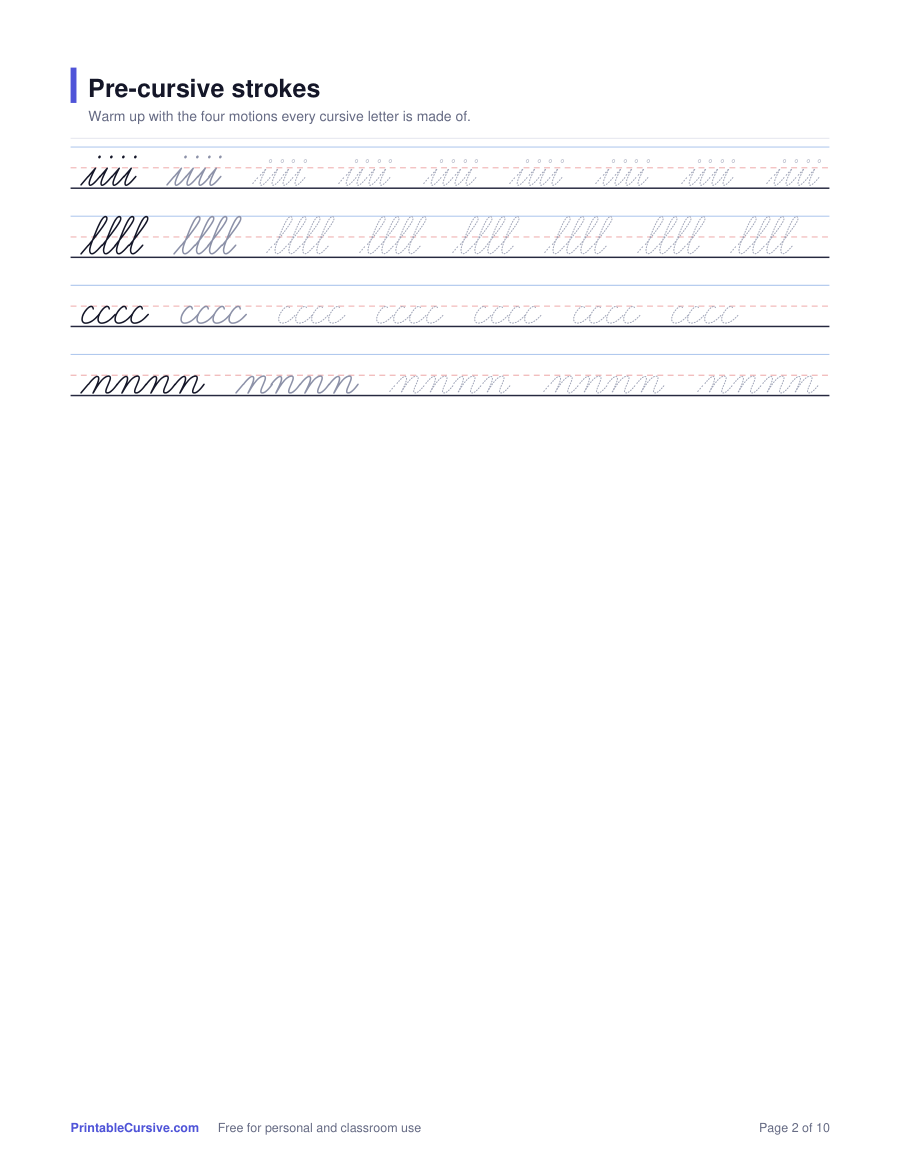
First year cursive starter pack
10 pages · US Letter, prints on A4 · free
Weeks 1 to 6: strokes, letters by family, the tricky letters, capitals, first words and sentences. One page per lesson.

Cursive practice sheets
8 pages · US Letter, prints on A4 · free
Weeks 7 to 12: letter rows for review, joins, words, sentences and free writing.
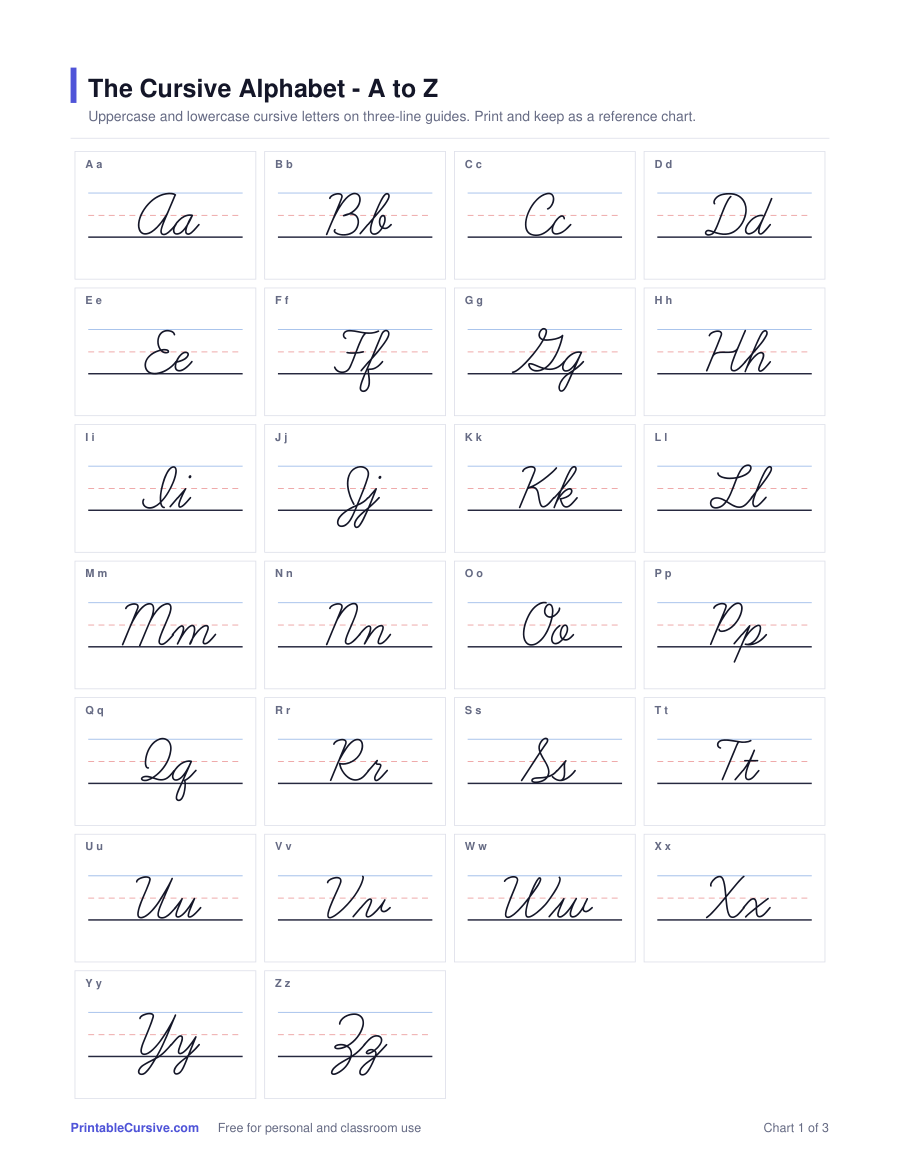
Cursive alphabet chart
3 pages · US Letter, prints on A4 · free
A wall chart and alphabet strips for desks.
Each letter also has a one-page worksheet with the strokes explained, reachable from the cursive alphabet. Blank paper in four rulings is on the handwriting paper page, and the by-grade guide matches printables to grade levels.
Which states require cursive
Cursive dropped out of many curricula after the Common Core standards of 2010 left it out, and it has been coming back state by state since. As of 2026, roughly half of the states require cursive instruction, either by statute or through their academic standards, and new laws pass most years (Pennsylvania's took effect for the 2026 school year). States with a requirement include:
Alabama, Arkansas, California, Delaware, Florida, Georgia, Idaho, Illinois, Kansas, Kentucky, Louisiana, Mississippi, Missouri, New Hampshire, New Jersey, North Carolina, Ohio, Oklahoma, Pennsylvania, South Carolina, Tennessee, Texas, Virginia, West Virginia.
The grade level varies: many require legible cursive by the end of 3rd grade, California covers grades 1 to 6, Arizona sets 5th grade. Laws change, so confirm with your state department of education. Sources: Education Week (November 2024) and the Zaner-Bloser state-law tracker.
Tips that make the difference
- Say the strokes aloud while modeling. "Undercurve, slant, undercurve" gives students words for what their hand does.
- Model on three-line guides on the board, not on plain lines, so heights are visible.
- Use a new letter in a word the same day. Letters practiced in isolation for a week are hard to join later.
- Left-handers tilt the paper the other way and keep the hand below the line. Seat them on the left end of a shared table.
- Grade legibility, not beauty. Consistent slant, height and spacing are the criteria; flourishes are not.
Teaching cursive questions
How long should a cursive lesson be?
Fifteen minutes, four or five times a week, is the sweet spot for second and third graders. Longer sessions produce fatigue and worse letters. The lesson structure on this page fits in fifteen minutes.
What order should I teach the cursive letters?
By stroke family, not alphabetically: undercurve letters (i, t, u, w, e, l) first because they are simplest and already make words, then the oval letters (a, c, d, g, o, q), then overcurve letters (n, m, v, x, y, z), then the hardest ones (r, s, f, k, j, p, b). Capitals come after the lowercase alphabet is fluent.
Which cursive style should I teach?
The one your school or district has adopted. If you homeschool and can choose, Zaner-Bloser is the traditional script most adults recognize, D'Nealian eases the print-to-cursive step, and New American Cursive is a simplified option. The worksheets here follow the Zaner-Bloser style.
Is cursive required in my state?
About half of the states require cursive instruction by law or by their academic standards, and the list grows most years. Check the list on this page and confirm with your state education department, since the grade level and the wording vary.