Congratulations in cursive
"congratulations" takes 4 strokes to write in cursive: the letters in one flow, then dot the i and cross the ts. Follow the letter-by-letter steps below and print the free worksheet to trace and copy it.
Lowercase
Capitalized
Free congratulations worksheet
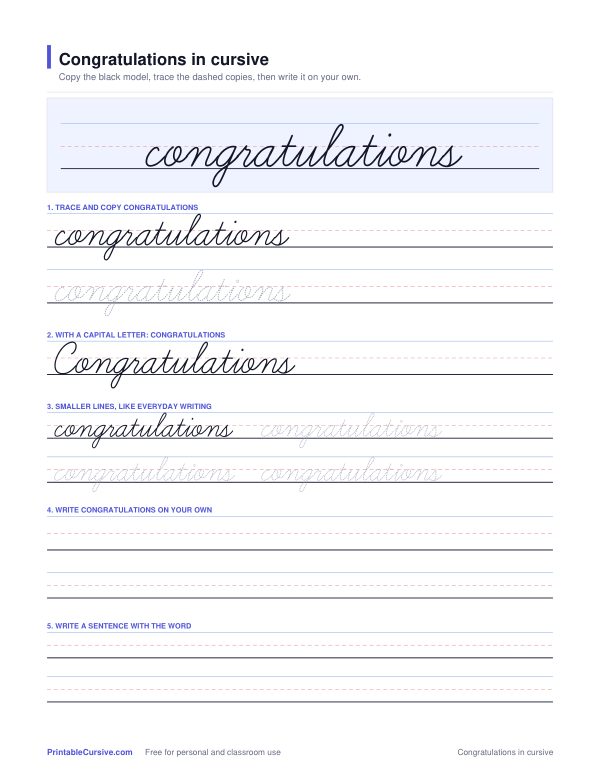
Congratulations in cursive practice sheet
1 page · US Letter, prints on A4 · free
"congratulations" on three-line guides in two sizes: a solid model, dashed copies to trace, and blank lines to write it on your own.
Want it with other words or a different line size? Use the worksheet generator.
How to write congratulations in cursive
- Start with the c (downcurve, undercurve): a single curve that opens to the right, like a print c with an undercurve out.
- Swing up into the o (downcurve, undercurve, checkstroke): a closed oval that ends with a checkstroke at the midline.
- From the checkstroke of the o, write the n (overcurve, slant, overcurve, slant, undercurve): two rounded humps made with overcurves.
- Swing up into the g (downcurve, undercurve, slant, loop, overcurve): the oval of an a followed by a descender loop that crosses back on the baseline.
- Swing up into the r (undercurve, slide right, slant, undercurve): an undercurve, a short slide to the right at the midline, then a slant down.
- Swing up into the a (downcurve, undercurve, slant, undercurve): a small oval closed at the midline, then a slant down and an undercurve out.
- Swing up into the t (undercurve, slant, undercurve; cross): a tall retraced undercurve and slant, shorter than the l, crossed after the word is written.
- Swing up into the u (undercurve, slant, undercurve, slant, undercurve): two undercurves side by side, the opposite motion of the n.
- Swing up into the l (undercurve, loop, slant, undercurve): one tall loop, the simplest tall letter.
- Swing up into the a (downcurve, undercurve, slant, undercurve): a small oval closed at the midline, then a slant down and an undercurve out.
- Swing up into the t (undercurve, slant, undercurve; cross): a tall retraced undercurve and slant, shorter than the l, crossed after the word is written.
- Swing up into the i (undercurve, slant, undercurve; dot): a short undercurve and slant, with the dot added after the word is finished.
- Swing up into the o (downcurve, undercurve, checkstroke): a closed oval that ends with a checkstroke at the midline.
- From the checkstroke of the o, write the n (overcurve, slant, overcurve, slant, undercurve): two rounded humps made with overcurves.
- Swing up into the s (undercurve, curve down, undercurve): an undercurve to the midline, a curve back down that closes on the upstroke, then an undercurve out.
- After the word, dot the i, cross the ts.
How the letters in congratulations connect
- co c to o: an undercurve join. The exit stroke of the c swings up into the o.
- on o to n: a checkstroke join. The o ends at the midline, so the n starts from the top instead of from the baseline.
- ng n to g: an undercurve join. The exit stroke of the n swings up into the g.
- gr g to r: an undercurve join. The exit stroke of the g swings up into the r.
- ra r to a: an undercurve join. The exit stroke of the r swings up into the a.
- at a to t: an undercurve join. The exit stroke of the a swings up into the t.
- tu t to u: an undercurve join. The exit stroke of the t swings up into the u.
- ul u to l: an undercurve join. The exit stroke of the u swings up into the l.
- la l to a: an undercurve join. The exit stroke of the l swings up into the a.
- at a to t: an undercurve join. The exit stroke of the a swings up into the t.
- ti t to i: an undercurve join. The exit stroke of the t swings up into the i.
- io i to o: an undercurve join. The exit stroke of the i swings up into the o.
- on o to n: a checkstroke join. The o ends at the midline, so the n starts from the top instead of from the baseline.
- ns n to s: an undercurve join. The exit stroke of the n swings up into the s.
The letters in congratulations
Congratulations questions
How many strokes does it take to write congratulations in cursive?
4 strokes: one continuous stroke for the letters, then dot the i, cross the ts. Inside a word the pencil stays on the paper; dots and crosses are added once the word is finished.
Which letters in congratulations are joined at the midline?
The o. This letter ends with a short bridge stroke at the midline, so the next letter starts from the top rather than from the baseline. That is what makes "congratulations" look different from a word with only baseline joins.
Is congratulations capitalized in cursive?
Only at the start of a sentence or in a title. In running text "congratulations" is written in lowercase, all letters joined. The capitalized form Congratulations is shown above for sentence openers and headings.
What is the hardest letter in congratulations?
The r and the s. r is the letter most adults get wrong. The slide right is tiny: think of a small step, not a hump. Cursive s is the most searched letter for a reason: it looks nothing like print. Write it as an upstroke with a little belly, not as a snake.